
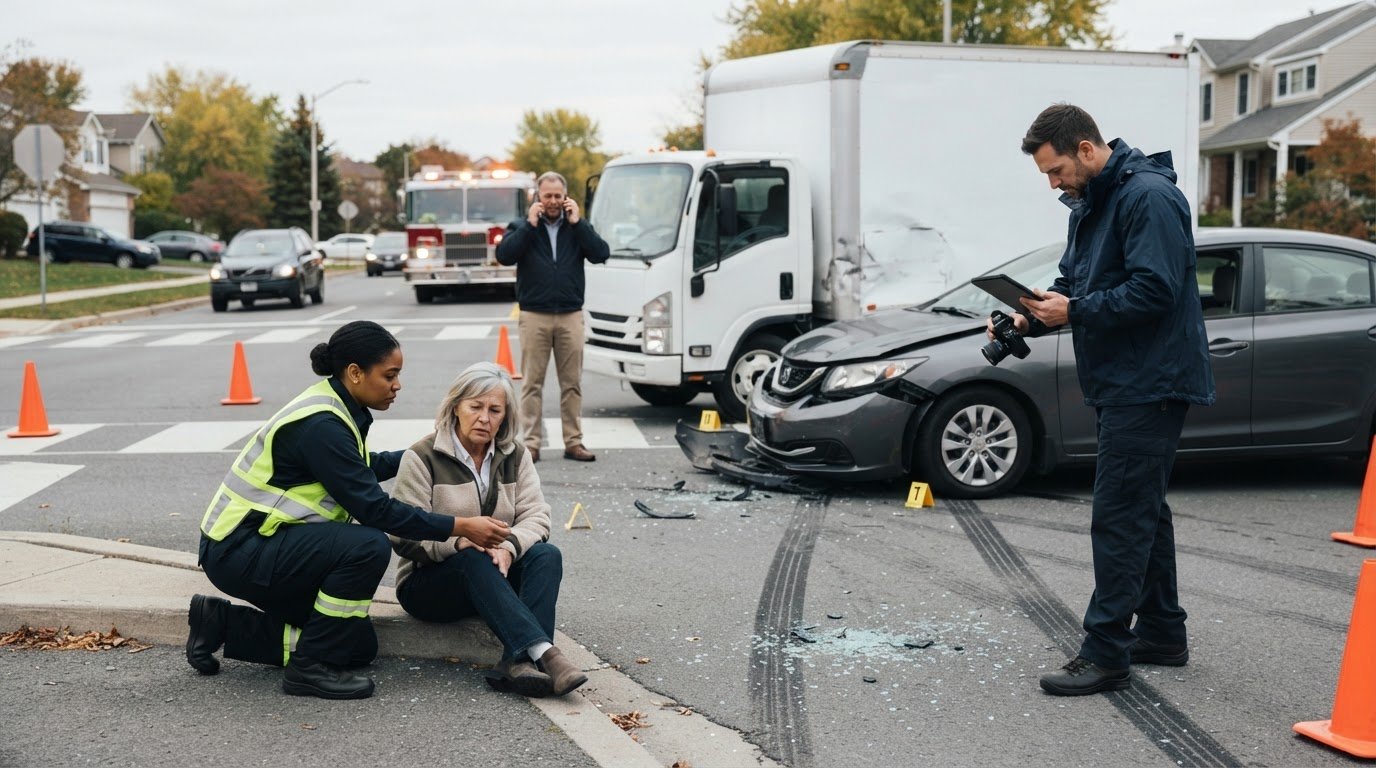
Liability in a Delivery Truck Accident: Who May Be Responsible?
What if the delivery driver who hit your car isn’t the only party whose actions matter? Liability in a delivery truck accident can involve the driver, the company that employs or contracts with them, or another party whose decisions contributed to the crash. To assess responsibility, investigators look at who controlled the work, what caused the collision, and whether it could have been prevented.
It’s understandable to be unsure where responsibility lies, especially when several companies or insurers may be involved. Evidence such as vehicle data, driver records, photos, and witness accounts can help clarify what happened. Some records may not be kept indefinitely, so note what evidence may exist and preserve what you can.
This article explains which parties and legal theories may be considered, how investigators assess fault, and what evidence may support a claim. It also covers how shared-fault rules and insurance can affect the process, why state law matters, and practical steps to preserve useful information without assuming who is responsible or what the outcome will be.
Key Takeaways
-
Liability in a delivery truck accident depends on the facts and applicable law. Being involved in the crash alone doesn’t establish fault.
-
Investigate the driver, employer, vehicle owner, cargo-related parties, and maintenance providers as possible contributors, not automatically responsible parties.
-
Compare photos, witness accounts, reports, and vehicle or work records. Each source can help explain what happened, but each has limitations.
-
State-specific shared-fault rules and insurance investigations can affect how a claim is assessed, so keep records and communications organized.
-
Prioritize safety and medical needs, then preserve available crash information and get guidance about your specific circumstances.
Table of Contents
-
Liability in a Delivery Truck Accident: What Determines Who Is at Fault?
-
Who May Be Liable in a Delivery Truck Accident?
-
What Evidence Helps Establish Liability in a Delivery Truck Accident?
-
How Shared Fault, Insurance, and State Law Can Affect a Claim
-
What to Do After a Delivery Truck Accident: Next Steps
Liability in a Delivery Truck Accident: What Determines Who Is at Fault?
Liability concerns legal responsibility, which is determined by the facts and the law that applies. Being involved in a collision or owning a vehicle involved in it doesn’t by itself establish legal fault. Depending on the evidence, responsibility may rest with one party or be shared among several. Rules for liability, filing deadlines, and claim procedures vary by state, so no single conclusion applies to every crash.
A crash cause explains how a collision may have happened; the legal basis for liability connects a party’s conduct to responsibility under the law. Investigators look beyond the fact that a delivery vehicle was present. They consider what each person or business did, how those actions relate to the collision, and whether the applicable legal requirements are met.
How negligence may apply to a delivery truck crash
Negligence is one legal theory that may be considered. In general terms, an investigation may examine whether someone had a duty to act with reasonable care, failed to do so, and thereby caused harm. These points require evidence and don’t guarantee that a claim will succeed.
For example, a delivery driver might fail to respond safely to slowing traffic. That could be one possible explanation for a rear-end collision, but it isn’t proof by itself. Investigators may assess the driver’s actions, traffic conditions, available records, and whether the conduct caused the injuries or other harm claimed.
Why delivery vehicle cases can involve several parties
The driver’s conduct is one part of the inquiry. Investigators may also examine the employer or motor carrier, the vehicle owner, a maintenance provider, or another party whose role may have contributed. A company could potentially face responsibility for a driver’s conduct under vicarious liability, depending on the relationship and circumstances. Each party’s connection to the crash must be assessed; appearing in the investigation doesn’t establish legal liability.
Understanding those roles can help clarify what questions to consider about a particular claim. For a broader overview of legal guidance after a crash, see Finding the Right Car Accident Lawyer: A Comprehensive Guide to Legal Recovery in 2026.
Who May Be Liable in a Delivery Truck Accident?
Identifying everyone whose conduct may matter is part of investigating liability in a delivery truck accident. The driver may be one focus, but ownership, work arrangements, vehicle condition, and other crash-specific facts can raise questions about additional parties. These are investigative leads, not a checklist of people or businesses automatically responsible. One collision may involve several contributing acts or omissions, and evidence must connect each party’s role to the crash.
Depending on the evidence, potential parties may include the delivery driver, an employer or delivery company, the vehicle owner, a maintenance provider, or another party whose conduct contributed to the crash. Responsibility depends on the specific facts and applicable law.
The delivery driver and the employer or delivery company
Investigators may review whether the driver was attentive, traveling at a safe speed for the circumstances, and operating the vehicle safely. They may also examine what the employer or delivery company required, supervised, or controlled. An employer’s responsibility can depend on state law, the driver’s work relationship, and whether the conduct occurred within the scope of the work.
A contract calling a driver an independent contractor doesn’t necessarily settle the issue. The actual relationship and work arrangement may need review. For context, the Federal Motor Carrier Safety Administration’s Large Truck and Bus Crash Facts provides official crash data, but broad statistics cannot establish who was responsible for an individual collision.
Vehicle owners, maintenance providers, and other possible parties
The registered owner may differ from the company that employs or dispatches the driver. That distinction can make ownership and vehicle-use records relevant, though ownership alone doesn’t prove fault. Maintenance or inspection records may help investigators assess whether a mechanical problem existed, when it was addressed, and whether it may have contributed. Those records should be considered alongside other evidence.
A manufacturer may be relevant if evidence points to a defective vehicle or component as a contributing factor. Cargo handling or loading may also warrant examination if the facts suggest that shifting, an unsecured load, or another loading issue affected the truck’s movement or the collision. Without evidence connecting those issues to the crash, they remain possibilities rather than established causes.
Sorting out overlapping roles can be challenging. If you’d like to discuss the circumstances of a specific crash with a legal professional, request a free MVA case evaluation.
What Evidence Helps Establish Liability in a Delivery Truck Accident?
Evidence helps connect the events before, during, and after a collision to the parties’ actions. No single photograph, report, or electronic record necessarily decides liability in a delivery truck accident. Investigators assess what each source can show, consider its limitations, and compare it with other available information.
Promptly preserving available evidence can help keep useful details from being lost or changed, even though there is no single preservation deadline that applies to every record or case. If it’s safe, keep copies of photos, contact information, reports, and relevant messages. Make a note of where additional records may exist, such as dispatch communications or vehicle data.
Evidence source What it may help establish Important limitations
Crash-scene and vehicle photos Vehicle positions, damage, road conditions, signs, and visible obstructions. Images capture only particular angles and moments; they may not show what happened before impact.
Witness accounts What a person saw or heard, such as vehicle movement or traffic conditions. Memory and vantage point can affect what a witness perceived.
Police reports Initial observations, statements, and recorded crash details. A report may not resolve disputed facts or determine legal responsibility.
Vehicle and electronic records Depending on the vehicle and data available, information about operation or a possible mechanical issue. Access, availability, and interpretation vary; event data recorders may not capture every relevant fact.
Delivery and work records Dispatch instructions, routes, delivery activity, work arrangements, or relevant communications. Records may be incomplete, unavailable, or require context to understand their significance.
Records that can clarify the driver’s actions and work relationship
Dispatch messages, route information, delivery records, and employment documents may help explain what the driver was doing and how the work was arranged. Driver logs or communications may also provide context when they exist and are relevant. Requirements and recordkeeping practices can differ, so don’t assume every delivery driver or vehicle is subject to the same federal rules. IIHS research on large trucks offers broader safety context, but it can’t establish what happened in a specific collision.
Physical, digital, and witness evidence
Photos of damage and scene conditions can complement witness statements and official reports. Electronic vehicle data may add another perspective, but it requires careful interpretation and may not explain why a driver acted as they did. For broader claim information, see Car Accident Legal Resources 2026: A Comprehensive National Guide. Considered together, these sources can help identify what is known, what remains disputed, and what additional information may be relevant.
How Shared Fault, Insurance, and State Law Can Affect a Claim
Evidence may help explain how a delivery truck crash happened, but questions can remain about how responsibility is assigned and how an insurer evaluates the claim. State law matters: rules for comparative or contributory fault, along with procedures and deadlines, vary. There isn’t one national standard for how a person’s own potential fault affects a claim.
Can more than one party share responsibility?
Yes. Evidence may indicate that more than one person or business contributed to a collision. For illustration, a truck driver and another road user might each have taken an action relevant to a crash. That example doesn’t establish fault or predict a legal result. How responsibility is divided, and what effect a claimant’s own conduct may have, depends on the applicable state law.
Why insurance findings and legal liability may differ
An insurer may review statements, records, vehicle damage, claimed losses, and competing accounts to assess coverage or consider a settlement. Commercial auto insurance may be relevant, but the existence, terms, and limits of any policy depend on the circumstances. An insurer’s initial position is not necessarily a final determination of legal responsibility. If a dispute reaches court, a court’s determination is a separate process governed by applicable law and evidence.
For a specific claim, keep communications and documents organized, and consider getting legal guidance before drawing conclusions from an insurer’s assessment. For broader information about representation considerations, see Comprehensive Guide to Choosing an Injury Attorney in 2026.
Discuss your delivery truck accident in a free MVA case evaluation