
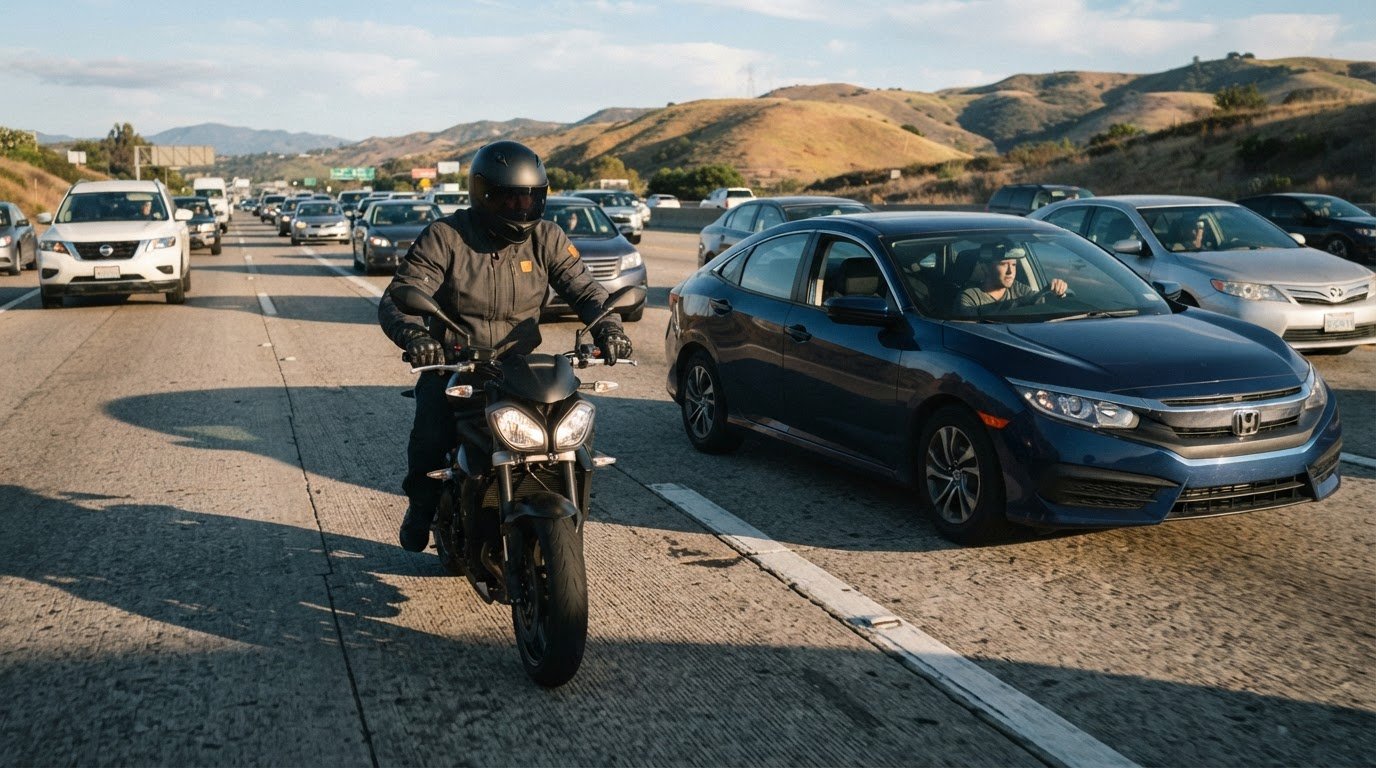
Motorcycle Lane Splitting Accident Fault in California
A motorcycle’s position between lanes doesn’t, by itself, decide who caused a California crash. California Vehicle Code section 21658.1 defines lane splitting as riding a motorcycle between rows of stopped or moving vehicles in the same lane, and lane splitting is lawful when done safely and prudently. Proving fault in a motorcycle lane-splitting accident means establishing what each person did before impact, including whether the rider was lane splitting or changing lanes.
It’s understandable to focus first on the motorcycle’s movement, but the other driver’s actions matter too. A driver who changes lanes without looking or signaling, or deliberately blocks a rider, may share responsibility for the collision.
This article explains how California assesses fault, how evidence such as police reports and witness statements can clarify what happened, and why insurers may dispute responsibility. It also explains how comparative negligence can affect compensation when more than one person contributed to a crash.
Key Takeaways
-
California permits lane splitting when it’s done safely and prudently, but that alone doesn’t determine fault.
-
Fault assessment considers both the rider’s conduct and how other drivers acted before the collision.
-
Comparative negligence can affect compensation when responsibility is shared.
-
Police reports and witness statements can help clarify what happened, but each piece of evidence has a role in the overall account.
-
Whether the rider was lane splitting or changing lanes at impact can shape how the crash is evaluated.
Table of Contents
-
Who's at Fault in California Lane Splitting Accidents?
-
Insurance disputes after a lane-splitting accident
-
Police reports and witness statements as evidence
-
How fault is assessed in a California lane-splitting crash
-
Establishing whether the motorcyclist was lane splitting at the time of the collision
-
EMS Accident Cases: Accident Claim Blog
Who's at Fault in California Lane Splitting Accidents?
California does not assign fault automatically because a motorcycle was between lanes. Under California Vehicle Code section 21658.1, lane splitting means riding between rows of stopped or moving vehicles in the same lane. It is lawful when performed safely and prudently, so the conduct of both the rider and other drivers matters.
An unsafe lane change may support a finding of negligence if it causes a collision. A driver who moves across a lane without looking or signaling, for example, may have failed to take reasonable care around nearby traffic. If that move strikes a lane-splitting motorcycle, the driver may be responsible, depending on the circumstances.
Other driver behavior can matter too. California law prohibits intentionally blocking or impeding a motorcyclist in a way that could cause harm. A driver weaving between lanes after using alcohol or drugs may create a dangerous situation, while failing to signal before changing lanes is a traffic violation. Such details can help show how the driver’s actions contributed to the impact.
The rider’s actions are assessed as well. Investigators and insurers may consider the rider’s speed, position, visibility, and ability to respond to surrounding traffic. A rider moving between stopped vehicles, for example, may face questions about whether the maneuver was safe and prudent. If a driver changed lanes without checking a mirror, disputed fault of 10-30% may arise in that type of scenario.
The point of impact can also help clarify what happened. Evidence that a motorcycle was rear-ended may support the position that another driver caused the crash, but it does not settle fault on its own. The sequence of movements and each person’s actions still matter. The key question is how those actions contributed to the collision, not simply whether lane splitting occurred.
California applies comparative negligence when responsibility is shared. A rider who contributed to a crash may still recover damages, but compensation is reduced by the rider’s percentage of fault. If both the rider and driver acted unsafely, for example, each person’s contribution can affect the allocation of responsibility. An insurer’s assessment is not a final determination.
The filing deadline depends on the type of claim and the defendant. It is separate from the question of who caused the crash. Identify those details promptly, since they determine which deadline applies to an injury claim.
Recoverable damages can include documented treatment costs, lost income, motorcycle repair, and other losses connected to the crash. Records help establish each loss and its connection to the collision. Under comparative negligence, the rider’s share of fault reduces the amount recoverable; for example, a 20% fault share leaves 80% of established damages before other applicable considerations.
Insurance disputes after a lane-splitting accident
Insurers investigate by comparing the driver’s and rider’s accounts with police reports, witness statements, and available crash evidence. They use this information to assess who was responsible and whether fault should be shared.
Insurer Arguments About Fault
An insurer’s fault argument explains how it believes each person’s conduct contributed to the collision. After a lane-splitting crash, an adjuster may argue that the rider’s speed, position, or movement made the impact avoidable. The insurer may also dispute a driver’s responsibility or claim that both parties contributed. Those positions matter because a 10-15% share of fault assigned to a rider can reduce compensation by that share.
An insurer might focus on the rider’s position between vehicles while giving less weight to the driver’s account of a lane change. Consider the evidence as a whole: a witness who describes the driver’s movement may support a different account. A police report can record scene details and statements made after the collision, but it does not automatically resolve every disagreement.
Insurance Fault Investigations
An insurance fault investigation is an adjuster’s review of the available information to assess how a crash happened and who may be responsible. It may involve comparing accounts, examining the police report, and considering witness statements. The review matters because the insurer’s assessment can shape settlement discussions, even if another party disputes its conclusions.
Small details can change how an account is understood. A witness who saw a vehicle move across the motorcycle’s path, for instance, may help clarify the sequence of events. An inconsistent account may prompt further questions. Organizing evidence by timing, vehicle positions, and point of impact can help explain which account fits the available information.
Communicate carefully with the other driver’s insurer. Motorcycle crash victims are generally advised to avoid discussing fault or giving that insurer a recorded statement before consulting counsel. An answer about speed or position may later be compared with other evidence, so don’t guess when describing what happened.
Keep settlement discussions separate from the question of what happened. An insurer’s offer reflects its assessment of the claim, while fault depends on evidence about the collision. If the adjuster assigns you a share of responsibility, ask what conduct and evidence support that position. A clear explanation can help identify the specific points in dispute.
When an insurer’s position conflicts with witness statements or the police report, legal assistance may help clarify the available options. You can request help connecting with an attorney to discuss a disputed motorcycle accident claim.
Police reports and witness statements as evidence
After a California lane-splitting collision, a police report and witness statements can help establish how the crash happened. They may clarify what each person saw, said, or did, although each source may capture only part of the event. Compare their details with the physical scene to see where accounts agree and differ.
A police report may record the location, people involved, officers’ observations, and statements gathered at the scene. It can provide a useful timeline, such as whether a vehicle was already changing lanes when the motorcycle arrived. The report is evidence to consider, not an automatic decision about legal fault. If it leaves out a key movement, other evidence may help fill the gap.
Witness accounts are most useful when they describe specific observations rather than conclusions. A driver behind the motorcycle might explain which vehicle moved first; someone near the shoulder might describe the vehicles’ positions after impact. Such details can help establish what another driver did. Record each witness’s contact information and account promptly, while the event is still clear to them.
Available video can add a visual record. A dashcam or nearby camera, for example, may show a vehicle moving across the motorcycle’s path, traffic conditions, or the sequence before impact. Footage may not capture the whole roadway or show what a driver noticed, so compare it with witness statements and the police report rather than treating it as the complete story.
Other evidence from the scene can help clarify an account. Photographs may show vehicle damage, debris, road markings, traffic signals, and the vehicles’ final positions. These details can matter when accounts differ about a lane change or reckless maneuver. Preserve original files when possible, and note where and when each photograph or recording was made.
If distracted driving is suspected, the evidence should connect the suspected conduct to the collision. A witness who saw a driver looking down, for instance, may provide context about the driver’s attention. That observation alone may not establish what caused the impact, but it can be considered alongside the timeline, video, and physical evidence.
For an injured rider, medical care comes first. Keep records of appointments, diagnoses, and treatment to document the injuries and their connection to the crash. Preserve receipts and communications related to the collision as well. Together, these materials can help explain how the crash occurred and what losses followed, which matters when seeking compensation.
Organize evidence by source and event: the police report, each witness’s account, original photographs or video, and medical records. This makes contradictions easier to spot, such as a statement describing a lane change that footage appears to place earlier. A clear, consistent record can support a more complete assessment of fault.
How fault is assessed in a California lane-splitting crash
California assesses fault by examining how each person’s conduct contributed to the collision. California Vehicle Code section 21658.1 addresses lane splitting, which is lawful when performed safely and prudently. The evaluation considers the rider’s actions alongside other drivers’ conduct, rather than treating lane splitting alone as proof of fault.
Speed and traffic conditions provide context for whether a rider’s conduct was prudent. California Highway Patrol guidance recommends lane splitting only when surrounding traffic is stopped or moving slowly, and considers it safest when traffic moves at 30 mph or less. The CHP advises against splitting above 30 mph and recommends no more than 10-15 mph faster than surrounding traffic. It also recommends far-left lanes #1 and #2.
Safer riding recommendations can provide context, but fault still depends on the specific facts of the collision. Investigators may consider traffic speed, the rider’s position, visibility, and the timing of vehicle movements. A driver’s actions matter too. The central question is whether anyone’s conduct contributed to the crash, including whether the rider could reasonably respond to surrounding traffic.