
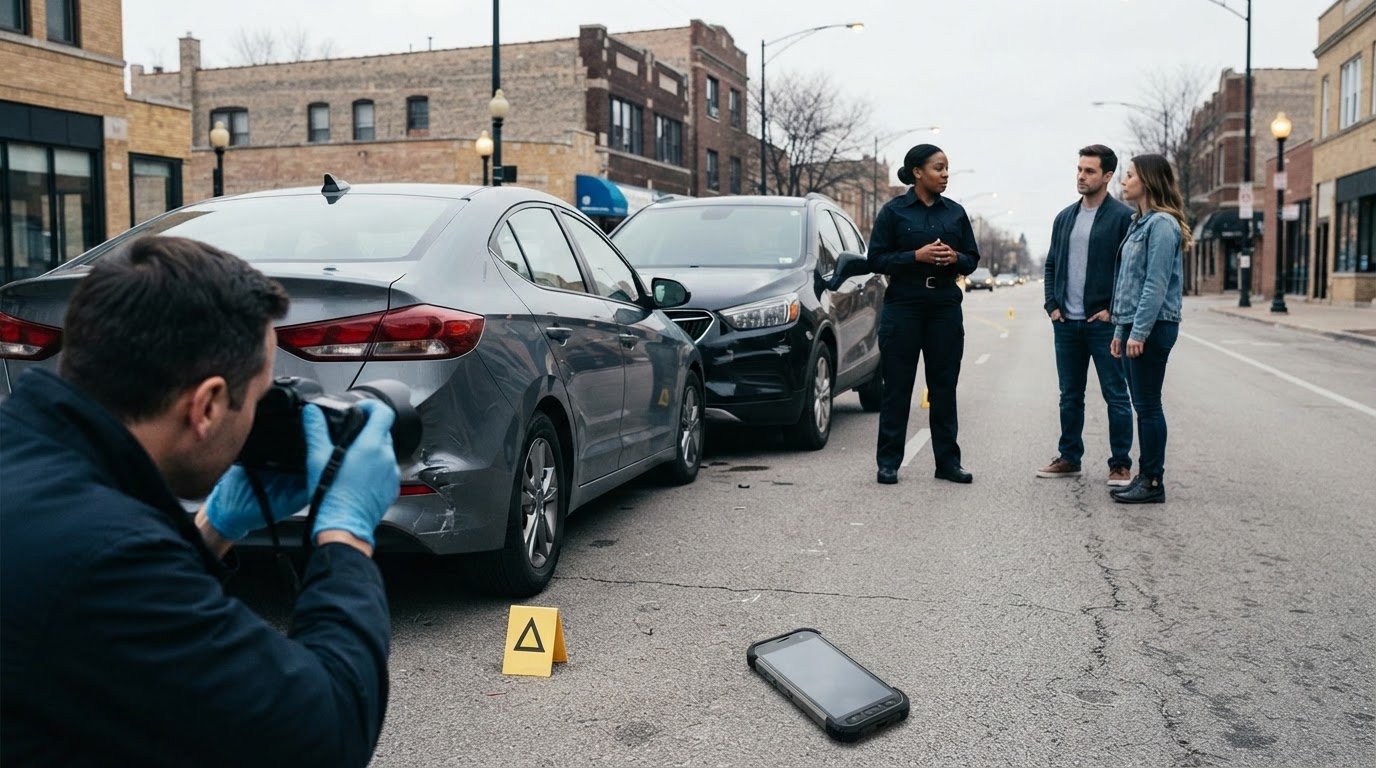
Rear-end collision fault determination: how evidence and liability are assessed
A rear-end impact doesn’t settle fault by itself. In Illinois, the rear driver is typically considered at fault, but evidence can show that another driver or a third party contributed to the crash. Rear-end collision fault determination also affects what compensation may be available: a person who is less than 50% at fault may recover compensation, reduced by their share of fault.
It’s understandable to assume the trailing driver is always responsible, particularly when following distance or inattention may have played a role. But the circumstances matter: a vehicle may have changed lanes abruptly, stopped unexpectedly, or been pushed into another car.
This guide explains how police reports, photos, videos, witness accounts, and other evidence can help establish what happened. It also covers Illinois following-distance rules, how third-party causes may affect liability, and how shared fault can affect a claim.
Key Takeaways
-
The rear driver is typically considered at fault, but the circumstances can shift or divide responsibility.
-
Compare the drivers’ accounts with scene photos, vehicle damage, witness statements, and available video to build a clearer picture of the collision.
-
In a chain-reaction crash, examine how each impact occurred and whether another driver, a vehicle defect, or a road hazard contributed.
-
Following distance, traffic conditions, and the lead driver’s actions all help assess whether a driver could stop safely.
-
In Illinois, a person less than 50% at fault may recover compensation, reduced by their percentage of fault.
Table of Contents
-
Who Is At Fault in a Rear-End Collision?
-
Police reports, physical evidence, and witness testimony
-
Third-party causes and chain-reaction collisions
-
Following distance and assured clear distance violations
-
Typical fault in Illinois rear-end collisions
-
EMS Accident Cases: Connect MVA Victims With Attorneys
Who Is At Fault in a Rear-End Collision?
The rear driver is typically considered responsible because drivers must leave enough space to stop safely. Fault may shift or be shared if the evidence shows another driver’s actions contributed.
Rear-end collision fault determination considers each driver’s actions before impact, not just which vehicle struck another. These factors help explain how liability is assessed.
Rear-Driver Duties and Fault Presumptions
A rear driver must maintain a safe following distance and pay attention to traffic ahead. In many states, the rear driver is generally presumed at fault because following too closely or inattention may cause a collision. That presumption is a starting point, not a substitute for examining the evidence.
Washington law requires drivers to follow at a distance that is reasonable and prudent for their speed, traffic, and road conditions, under 46.61.145. Washington courts may assign a rear driver anywhere from 0% to 100% fault, depending on the circumstances. A driver’s speed, visibility, and response to slowing traffic can therefore matter.
Exceptions and Front-Driver Actions
An exception may apply when the lead driver’s actions helped cause the crash. For example, a driver who merges or turns directly in front of another vehicle without enough space may contribute to the impact. Evidence about the timing and position of the maneuver can help distinguish an unavoidable gap from unsafe driving.
Other relevant actions include cutting off another driver, stopping suddenly without cause, or reversing into the vehicle behind. Missing or malfunctioning brake lights may also affect whether the rear driver had a fair chance to react. A sudden stop alone does not establish fault: the reason for braking and surrounding traffic conditions matter.
Negligence and Comparative Fault
Negligence means failing to use reasonable care, and comparative fault assigns responsibility according to each driver’s actions. In Illinois, a person who is less than 50% at fault may recover compensation, reduced by that person’s percentage of fault. For example, a 20% fault share reduces the recoverable amount by 20%.
A fault finding can affect how insurers allocate covered losses and assess premiums at renewal. A deductible is governed by the insurance policy, while compensation may be reduced by a claimant’s share of fault. Insurance notice and lawsuit filing have separate deadlines. Policies typically require prompt notice, often within 24-48 hours; the applicable lawsuit deadline depends on the claim and governing limitation period.
Disputing an Insurer's Fault Decision
A driver can dispute an insurer’s decision by identifying specific errors and presenting evidence that addresses them. A written response, for example, can explain how an unsafe, sudden merge conflicts with the insurer’s account. Attach relevant scene photos, video, witness statements, or vehicle-damage records, and ask the insurer to explain how it evaluated the evidence.
Keep copies of the decision, correspondence, and submitted materials so the disagreement is documented. If the decision overlooks evidence or applies the wrong account of events, request a review that addresses those points. Promptly notify the insurer, since policies typically call for notice within 24-48 hours; legal filing deadlines follow a separate limitation period.
Police reports, physical evidence, and witness testimony
Fault depends on how clearly the evidence explains the events before impact. In an Illinois rear-end crash, police reports, scene images, witness accounts, and vehicle records can help compare each driver’s version.
Evidence for Establishing Liability
Evidence helps establish liability by connecting a driver’s actions to the collision and resulting damage. In Illinois, it may include police reports, scene photos and videos, witness statements, traffic-camera or dashcam footage, cell-phone records, and expert testimony.
Each item can answer a different question. Photos may show where the vehicles stopped, while damage patterns can help clarify which parts made contact. Video may capture a lane change or sudden stop. Cell-phone records may be relevant if distraction is alleged. Together, these details can support or challenge a driver’s account.
Reports and Witness Testimony
A police report can document information gathered at the scene, while witness testimony can add an independent account of the crash. Both may help organize conflicting descriptions, but the specific observations matter.
For example, a witness who saw a vehicle change lanes just before impact may help explain why the following car had little time to react. A report may record driver statements, vehicle positions, or visible damage. Compare those details with photos and video rather than treating any one record as the complete story.
Witnesses may remember different parts of an event. One person might see the lead vehicle’s brake lights; another might notice the traffic signal or lane position. Names and contact details help identify who observed what, while clear descriptions distinguish firsthand observations from assumptions.
Evidence Collection and Documentation
After a car accident, organize the available evidence and preserve its context. If it is safe, photograph the vehicles, their positions, roadway conditions, visible damage, and nearby traffic signs or signals. Take both wide views and close-ups: a close-up shows damage, while a wider image shows where it occurred.
Preserve original photos and videos, including dashcam footage, rather than relying only on cropped or edited copies. Note when and where each image was taken, and keep copies of the police report, witness details, and relevant messages or records. These steps help connect each item to the same crash.
Write down what you recall while the sequence is clear, separating what you saw from what someone else reported. For example, record whether you saw brake lights before impact, or learned that detail from a witness. Keep records together for an insurance discussion or legal consultation. If you need guidance about organizing an accident claim, you can share your questions about the claim.
Third-party causes and chain-reaction collisions
A rear-end crash can involve more than the two drivers at the point of impact. Identifying who caused each collision matters when several vehicles, road conditions, or outside parties may have contributed.
Third-Party Causes
A third party may contribute to a rear-end collision through a defective vehicle part, negligent repair, a road hazard, or an on-duty driver’s actions. The driver directly behind the lead vehicle may not be the only cause of the crash.
For example, a mechanic’s faulty brake repair could affect a vehicle’s ability to stop, while a road hazard could prompt sudden braking. A defective part’s manufacturer or an employer of an on-duty driver may also be relevant. The legal basis for assigning responsibility depends on the circumstances and applicable state law.
Separate cause from proximity. A vehicle behind another at impact may have contributed through following distance or inattention, while an outside factor may have set events in motion. Insurers may assess each account and the available evidence when evaluating responsibility. An attorney can explain how a potential third-party claim relates to a driver’s claim for compensation.
Chain-Reaction Collisions
A chain-reaction collision occurs when one impact triggers additional impacts among vehicles. This matters because the first contact and later contacts may have different causes and involve different drivers.
Imagine a vehicle stopping for traffic, then being struck from behind and pushed into the car ahead. The middle driver’s vehicle may be involved in two impacts, but that alone does not show whether the middle driver had already struck the lead car. The sequence, spacing, and movement of each vehicle help distinguish those possibilities.
For each contact, consider who was moving, who had stopped, and whether another impact pushed a vehicle forward. A collision diagram or separate descriptions of each impact can help clarify the sequence. Those distinctions matter when insurers assess which driver’s actions caused particular damage.
Common Causes and Their Effects
Rear-end crashes commonly occur when the lead vehicle slows or stops while the approaching vehicle is traveling faster. Following too closely, distraction, speeding, and failing to brake or steer safely can contribute. Traffic congestion can turn one delayed response into several impacts, especially when vehicles are close together.
Rear-end collisions account for almost 29% of all crashes nationwide, according to the National Highway Traffic Safety Administration. That frequency does not establish fault in a particular crash. Instead, the circumstances show whether a driver behind had time and space to respond, or whether another action contributed.
When a third party may have caused or worsened the sequence, organize the account around each impact and each vehicle’s movement. For questions about how responsibility may be assessed, you can discuss the circumstances of your collision.
Following distance and assured clear distance violations
Following distance is assessed in light of conditions at the time, not just the gap between vehicles. Washington and Nevada frame the duty around a distance that is reasonable and prudent.
Safe Following Distance Requirements
Washington law requires drivers to follow at a distance that is reasonable and prudent for their speed, traffic, and road conditions under 46.61.145. This standard matters because the same gap may offer different stopping opportunities as traffic or road conditions change.