
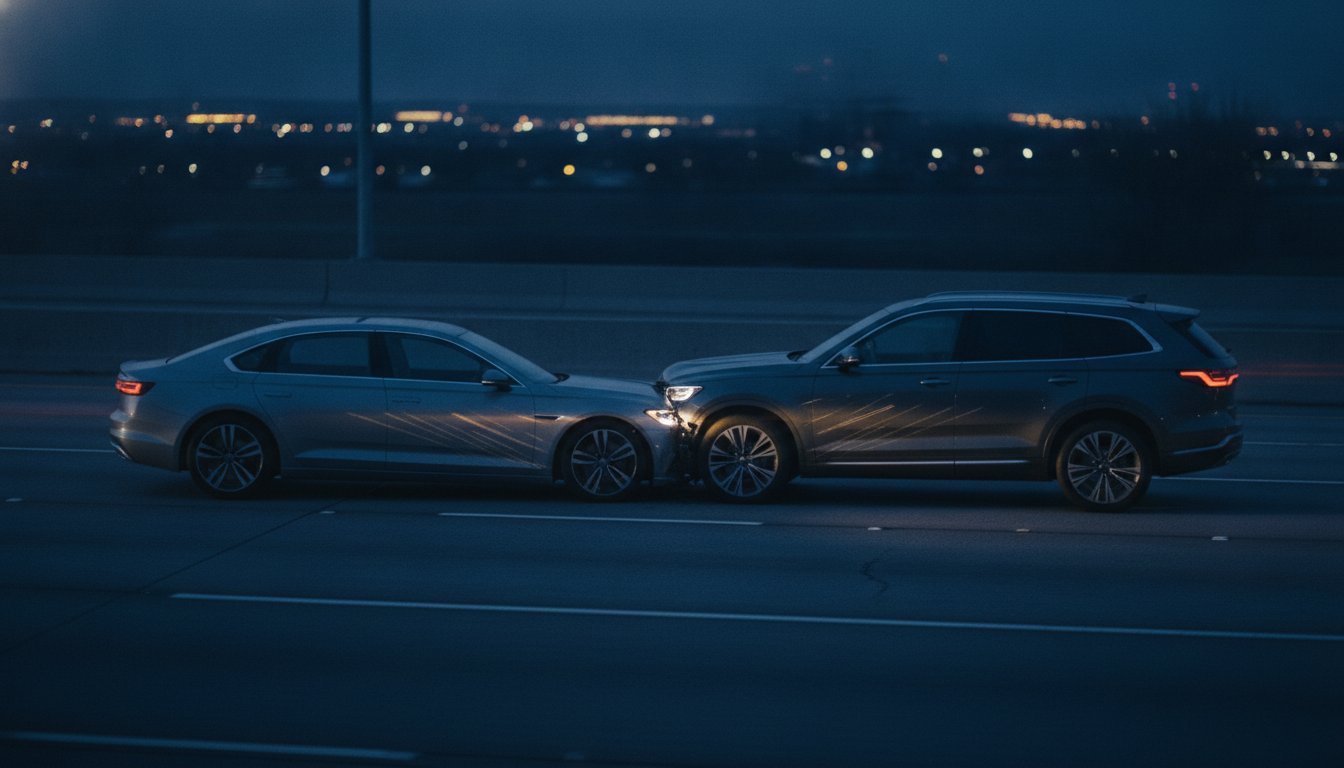
Sideswipe Car Accident Guide: Determining Fault, Liability, and Legal Recovery in 2026
Did you know that sideswipe accidents accounted for nearly 21% of all vehicle collisions in major hubs like Los Angeles in 2025? While these crashes often seem minor at first, a sideswipe car accident frequently turns into a complex "word-against-word" dispute that leaves victims fighting to prove they weren't at fault. It's a stressful situation, especially when insurance adjusters seem more interested in protecting their bottom line than looking at the actual evidence on the road.
We understand that facing skepticism from an insurance company while dealing with vehicle repairs can feel overwhelming. This guide provides the clarity you need to manage the legal landscape of 2026, from identifying the physics of a lane-departure impact to documenting the scene effectively. You'll learn the specific steps required to establish liability and how to connect with professional resources that simplify the path toward a fair recovery. We will examine the latest traffic safety trends, common evidence-gathering mistakes, and the role of expert evaluations in resolving fault disputes.
Key Takeaways
-
Understand the physics of parallel impacts and the critical distinction between merging errors and opposite-direction swipes.
-
Learn how the legal "Duty of Care" establishes lane maintenance responsibilities and how to identify the primary vehicle that deviated from its path.
-
Recognize how distracted driving and improper merging contribute to a sideswipe car accident, providing a basis for your liability claim.
-
Identify the essential evidence needed to secure a recovery, including dashcam footage and paint transfer analysis that resolves conflicting stories.
-
Gain insights into why insurance companies frequently deny these claims and how a professional evaluation helps overcome "word-against-word" challenges.
Table of Contents
-
Understanding Sideswipe Car Accidents: Definitions and Dynamics
-
Determining Fault in Sideswipe Collisions: The Legal Framework
-
Common Causes and Hidden Dangers of Side-to-Side Impacts
-
Critical Evidence: How to Prove Liability in a Sideswipe Claim
-
Navigating the Recovery Process: Connecting with Legal Support
Understanding Sideswipe Car Accidents: Definitions and Dynamics
A sideswipe car accident occurs when the lateral surfaces of two vehicles make contact while traveling in a parallel or near-parallel direction. While these incidents are sometimes dismissed as minor scrapes, the underlying side collision dynamics reveal a much more dangerous reality. The impact usually occurs along the doors, fenders, or side mirrors, but the resulting transfer of energy can easily destabilize a vehicle, especially at highway speeds.
One of the most hazardous elements of these crashes is the "surprise factor." Because the impact happens to the side of the vehicle, drivers often have no visual warning before the collision. This lack of preparation leads to reflexive overcorrection. When a driver instinctively jerks the steering wheel away from the point of impact, they often lose steering control entirely. This loss of stability frequently leads to secondary collisions, such as striking a concrete median, sliding into a guardrail, or triggering a multi-car pile-up in heavy traffic.
Same-Direction Sideswipes: Merging and Lane Changes
These collisions are most frequent on multi-lane highways and at busy urban intersections. They typically happen when a driver attempts to change lanes without properly checking blind spots or misjudging the speed of adjacent traffic. At high speeds, even a light touch can mimic the physics of a "PIT maneuver," forcing the struck vehicle into a dangerous sideways skid. In 2025, unsafe lane changes remained a primary cause of these incidents in major metropolitan areas like Los Angeles.
Opposite-Direction Sideswipes: The 'Sideswipe Head-On'
These occur on two-lane roads when a vehicle drifts across the center line. The danger lies in the extreme relative velocity; if two cars travel at 50 mph in opposite directions, the impact force reflects a 100 mph interaction. These "sideswipe head-ons" often result in catastrophic debris, such as sheared-off mirrors and shattered glass. Because of the high speeds involved, these accidents are significantly more likely to cause severe injuries than merging incidents.
Whether the impact is a result of a merging error or a center-line drift, the mechanical forces involved can cause significant structural damage that isn't always visible at first glance. Understanding these dynamics is the first step in building a case that accurately reflects the severity of the incident and the necessity of a professional evaluation.
Determining Fault in Sideswipe Collisions: The Legal Framework
Establishing liability after a sideswipe car accident begins with the legal concept of "Duty of Care." Every driver has a statutory obligation to maintain a single lane of travel and ensure any lane change is made with reasonable safety. When a vehicle crosses a solid or dashed line and strikes another car, they have breached this duty. While the physical mechanics of the crash might seem straightforward, proving which vehicle actually deviated from its path requires a methodical look at the evidence.
Insurance companies often struggle with these claims because they frequently lack the clear point-of-impact data found in rear-end collisions. Without definitive proof, adjusters often default to a 50/50 fault split, claiming that both drivers were equally responsible. This "he-said-she-said" dilemma can be frustrating for victims who know they stayed within their lane. To counter this, auto accident lawyers analyze police reports, witness statements, and electronic data to reconstruct the moment of impact. According to NHTSA traffic safety data, millions of police-reported crashes occur annually, and the narrative within these reports is often the key to overturning an unfair fault assessment.
The Dual-Merging Scenario
One of the most complex liability disputes occurs when two vehicles attempt to move into the same center lane simultaneously. In these cases, right-of-way rules usually favor the vehicle that was further ahead or, in certain jurisdictions, the vehicle merging from the left. Determining fault requires a precise timeline of who initiated the blinker first and who had established lane presence. These cases often result in shared liability because both drivers may have failed to notice the other's movement.
Comparative Negligence and Shared Liability
Even if the other driver clearly swerved into you, your own actions can impact your final settlement. Many states follow a "Pure Comparative Negligence" model, which means your recovery is reduced by your percentage of fault. For example, if a court finds you were 10% at fault because you were speeding at the time of the impact, your total compensation will be reduced by that 10%. Insurance adjusters look for any reason to assign a portion of the blame to you to lower their payout. Understanding how these percentages are calculated is essential for protecting your right to a fair recovery. If you are unsure how these rules apply to your specific situation, you can request a case evaluation to gain professional clarity on your options.
Common Causes and Hidden Dangers of Side-to-Side Impacts
Distracted driving remains the leading cause of unintentional lane drifting in 2026, contributing to an estimated 23% of all sideswipe incidents. Whether it's a momentary glance at a device or a lapse in focus, these small deviations lead to significant consequences. According to highway safety statistics, the economic cost of distracted driving has reached billions of dollars, reflecting the severe property damage and medical expenses associated with these crashes. Beyond driver behavior, improper merging accounts for over half of all sideswipe accidents, typically involving a failure to signal or a misjudgment of the speed of adjacent traffic.
Environmental factors also play a critical role in side-to-side collisions. Sudden gusts of wind can push high-profile vehicles out of their lane, while ice or patches of standing water can cause a car to hydroplane into a neighboring vehicle. In these situations, the driver who left their lane is still often held liable, as the legal framework expects operators to adjust their speed and caution based on current road conditions. If you've been forced into another vehicle due to weather, documenting the specific conditions at the time of the crash is vital for your claim.
One of the most significant risks after a sideswipe car accident is the potential for hidden mechanical damage. Because the impact is spread across a large surface area, the external damage might only look like a long scrape or a dented fender. However, the force of a lateral hit can easily bend suspension components, damage steering linkages, or knock wheels out of alignment. If left unaddressed, these issues can lead to tire blowouts or a total loss of steering control later on. It's essential to have a professional technician inspect the vehicle's frame and alignment even if the car still feels drivable.
Blind Spot Negligence
Modern vehicles are equipped with Advanced Driver Assistance Systems (ADAS) designed to alert drivers to nearby cars, but technology doesn't absolve a driver of their duty to look. Sensors can fail due to dirt, heavy rain, or technical glitches. Legally, the responsibility to check blind zones remains with the human operator. In a dispute, ADAS data from a vehicle's onboard computer can often be used as evidence to prove whether a driver ignored a warning before a collision occurred.
High-Speed Highway Risks
At highway speeds, a sideswipe often triggers a chain reaction that disables multiple lanes of traffic. The initial impact is rarely the end of the event; it's usually the catalyst for a much larger wreck. The overcorrection trap occurs when a driver reacts to a side impact by jerking the wheel too sharply in the opposite direction, often causing a rollover or a secondary collision with oncoming traffic; always maintain a firm, steady grip and avoid sudden steering movements to minimize the risk of a catastrophic spinout.
Critical Evidence: How to Prove Liability in a Sideswipe Claim
Proving liability in a sideswipe car accident often feels like an uphill battle because the physical damage rarely tells the whole story. While a rear-end collision has an obvious point of impact, sideswipes involve side-to-side contact that makes it easy for both parties to claim they stayed within their lane. To move beyond a "he-said-she-said" stalemate, you must gather objective data that reconstructs the seconds leading up to the crash. Without this proof, insurance adjusters frequently default to shared fault, which can significantly reduce your compensation.
Dashcam footage has become the gold standard for resolving these disputes in 2026. A clear video shows the vehicle's position relative to the lane lines and captures the exact moment the other driver drifted. Paint transfer and scrape patterns also provide a physical map of the collision. Investigators look at the direction of the scratches; for instance, if paint is smeared from the front of your car toward the back, it suggests the other vehicle was traveling faster or merged into you while you were maintaining a steady speed. Witness statements from neutral third parties are equally vital, as they offer an "outside-in" perspective that insurance companies find more credible than the accounts of the involved drivers.