
Steps to Take After a Minor Car Accident: A Practical 2026 Checklist
A low-speed fender bender can create just as much financial and legal disruption as a severe collision. Knowing the exact steps to take after a minor car accident is essential, particularly when complex vehicle sensors conceal underlying frame damage and physical injuries take days to manifest.
It's completely normal to feel uncertain about whether minor property damage warrants calling law enforcement, filing a formal insurance claim, or simply exchanging contact details. Handling pressure from adjusters who demand early recorded statements only amplifies that stress. This national guide provides an organized checklist detailing immediate roadside safety protocols, thorough evidence preservation, and critical documentation techniques that protect you from disputable claims and unexpected repair bills.
Below, you'll find a clear breakdown of essential post-collision procedures, common communication missteps to avoid, and the practical criteria that indicate when a professional case evaluation is warranted.
Key Takeaways
-
Master immediate roadside safety protocols to secure the crash scene, protect passengers, and document baseline details without compromising your position.
-
Follow the practical steps to take after a minor car accident to gather airtight photographic and driver evidence before vehicles leave the roadway.
-
Identify latent crash injuries such as whiplash and concussions that adrenaline surges frequently mask during early post-impact hours.
-
Communicate verifiable facts to insurance adjusters while avoiding premature assessments or high-pressure recorded statements.
-
Recognize critical warning signs like disputed liability or complex vehicle sensor damage that signal when a professional case evaluation is warranted.
Table of Contents
-
Immediate Roadside Safety and Scene Management Protocols
-
Comprehensive Evidence Collection and Information Gathering on Scene
-
Why Latent Injuries Require Prompt Post-Accident Medical Evaluation
-
Navigating Insurance Notifications and Protecting Legal Rights
-
Determining When Legal Guidance Is Necessary After Minor Collisions
Immediate Roadside Safety and Scene Management Protocols
The seconds directly following a crash require quick, structured decision-making. Knowing the immediate steps to take after a minor car accident protects both physical safety and future claim viability. Begin by taking a deep breath and checking yourself, your passengers, and the occupants of the other vehicle for visible injuries or physical shock. Even low-speed impacts transfer significant kinetic energy through the vehicle cabin.
Securing the Collision Area and Preventing Secondary Hazards
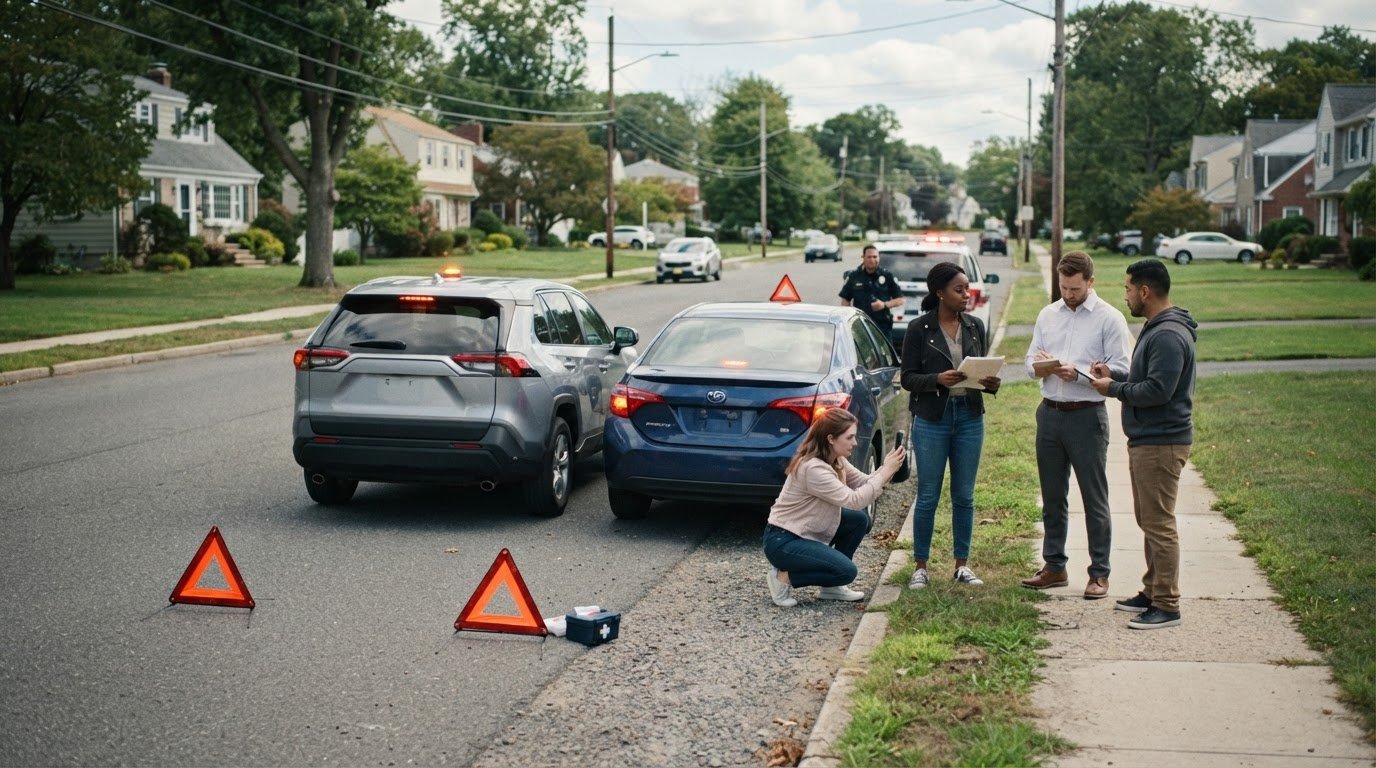
Secondary collisions on busy roadways often cause far more severe harm than the initial bump. If both vehicles remain operable and there are no catastrophic injuries, activate your hazard flashers and move cautiously onto the nearest shoulder or emergency lane. In any traffic collision overview, risk management prioritizes clearing the active travel lanes to prevent multi-vehicle pileups.
Keep these physical safety measures in mind before stepping out of the car:
-
Turn off the ignition: Switch off the engine immediately to eliminate the threat of electrical sparking or ignition of leaking fluids.
-
Assess traffic before exiting: Never step directly into an active traffic lane. Exit through the passenger door if shoulder space on the driver's side is tight.
-
Deploy warning devices: Position reflective triangles or road flares roughly 100 to 200 feet behind your vehicle if visibility is poor or you are stranded near a curve.
-
Stand away from the roadway: Move behind a guardrail or well onto the grassy verge while waiting for assistance.
Contacting Law Enforcement for Official Documentation
A frequent error drivers make during minor collisions is agreeing to settle things privately without calling dispatch. You should always request a police presence. A responding officer creates an objective incident report that verifies the date, time, weather, and basic statements from both motorists. Without this official baseline, insurance adjusters frequently treat claims as unverified word-against-word disputes.
When the officer arrives, answer questions directly using clear facts. Note the officer's name, badge number, and the incident report reference number before leaving the area. Keep your composure during all roadside exchanges with other motorists. Never offer casual apologies, speculate on your speed, or admit blame out of politeness, because opposing insurers routinely interpret polite statements as formal admissions of liability. Mastering these initial steps to take after a minor car accident ensures your safety remains intact while preserving your legal footing from the very start.
Comprehensive Evidence Collection and Information Gathering on Scene
Thorough documentation serves as your primary defense against disputable claims and sudden liability shifts. Motorists often encounter an at-fault driver who proposes an informal cash payout on the spot to avoid notifying insurers. Always decline these arrangements. Unseen structural issues frequently emerge days later, and without documented evidence, recovering repair expenses becomes nearly impossible once you drive away.
Exchanging Essential Driver and Vehicle Information
Approaching information collection methodically ensures you do not miss critical administrative details. Verify that the person behind the wheel is actually the named insured on the policy, as non-owner drivers can introduce coverage complexities.
-
Personal identifiers: Record the driver's full legal name, active phone number, physical residential address, and driver's license number.
-
Vehicle specifications: Document the make, model, model year, license plate, and the 17-digit Vehicle Identification Number (VIN) found on the lower driver-side dashboard.
-
Coverage confirmation: Transcribe the insurer's exact name, the active policy number, and the policy expiration date.
Photographic Evidence and Environmental Documentation
Capturing comprehensive imagery immediately after impact provides objective proof of the crash mechanics. Take wide-angle establishing shots that display both vehicles in their post-collision positions, followed by close-ups of specific panel scratches, bumper misalignments, and cracked lighting assemblies. Document the surrounding environment thoroughly, including posted speed limits, skid marks, obscured street signs, traffic signal phases, and wet roadway surfaces. Official procedures outlined in a state crash reporting guide highlight that physical roadway evidence often establishes fault faster than conflicting driver recollections.
Securing Impartial Third-Party Witness Statements
Neutral bystanders provide vital support when opposing drivers alter their accounts later. Approach witnesses calmly, ask what they observed, and request their full names and phone numbers. If they agree, record a brief voice memo on your smartphone summarizing their vantage point while recollections remain crisp. These practical actions represent vital steps to take after a minor car accident before the scene clears.
You can learn more about preserving critical crash documentation through our car accident legal resources library. When conflicting accounts create confusion about property damage or responsibility, you can request a free case evaluation to gain clarity on your options.
Why Latent Injuries Require Prompt Post-Accident Medical Evaluation
Adrenaline surges during an impact naturally dull pain receptors. You might feel fine at the scene, only to discover severe discomfort hours or days later. Insurers often seize upon gaps between the collision date and initial medical treatment to claim your discomfort stems from everyday activities rather than the wreck. Seeking an objective clinical assessment is one of the most critical steps to take after a minor car accident, even if you see no visible bleeding or bruising.
Understanding Hidden Trauma and Delayed-Onset Symptoms
Low-speed bumper impacts generate rapid acceleration-deceleration forces that transfer directly into human connective tissue. When muscles and ligaments stretch beyond their anatomical limits, microscopic tearing occurs without obvious external signs.
Watch closely for these common delayed physical conditions:
-
Cervical whiplash: Stiffness, reduced range of motion, and radiating shoulder tension often take 24 to 72 hours to manifest fully.
-
Traumatic brain injuries: Mild concussions can occur without direct head impacts. Symptoms include persistent headaches, sensitivity to sound, dizziness, and mild cognitive fog.
-
Lumbar and thoracic sprains: Lower back soreness frequently intensifies as soft-tissue inflammation peaks days post-collision.
Visit an urgent care center, an emergency department, or your primary physician within 24 to 48 hours. Medical professionals can conduct physical examinations and order diagnostic imaging before minor micro-trauma develops into chronic pain.
Building an Incontestable Medical Paper Trail
Insurance claims rely heavily on objective clinical records. Inform the examining healthcare provider immediately that your visit stems from a motor vehicle collision. This detail ensures the intake documentation explicitly ties your diagnostic findings to the vehicular incident from day one.
Maintain complete compliance with all prescribed clinical instructions. If a clinician recommends diagnostic scans, physical therapy sessions, or specific prescription medications, follow through without creating unexplained treatment gaps. Keep an organized folder containing discharge instructions, work restriction notices, diagnostic imaging reports, and itemized facility bills. Maintaining a contemporaneous daily symptom journal detailing your discomfort, mobility limitations, and missed sleep also provides indispensable corroboration. Prioritizing timely healthcare assessment among the early steps to take after a minor car accident protects your physical recovery while insulating your personal injury claim against aggressive adjuster skepticism.
Navigating Insurance Notifications and Protecting Legal Rights
Initiating an insurance claim requires balancing contractual compliance with strategic communication. While your personal auto policy contains a standard cooperation clause requiring timely notification, you are under no obligation to volunteer speculations. Understanding the appropriate communication boundaries forms a core part of the steps to take after a minor car accident, protecting you from unintended liability shifts during initial claims processing.
Reporting the Incident Without Compromising Claim Integrity
Notify your personal auto insurance provider promptly after leaving the scene. When speaking with your claims representative, provide strictly baseline objective data: the date, exact time, location, involved vehicles, and the official police incident report number. Avoid giving unprompted opinions regarding driver fault or declaring outright that you are entirely uninjured, since soft-tissue inflammation often takes days to surface.
Handling Adjuster Tactics and Early Settlement Pressures
Third-party insurance adjusters representing the other driver often initiate contact quickly. Their objective centers on minimizing payout exposure for their employer. Adjusters may use friendly, conversational tones while attempting to secure an early recorded interview or proposing a fast, modest settlement check to close the claim file.
Keep these protective measures in mind during every claims conversation:
- Decline recorded statements to opposing insurers: You are not legally required to provide a recorded interview to the other driver's insurance carrier without seeking legal counsel first.