
T-Bone Car Accident Fault: Determining Liability and Seeking Recovery in 2026
If both drivers claim they had the green light, who is truly responsible for the wreckage? This question is at the heart of many legal disputes, as determining t-bone car accident fault is rarely as simple as seeing who hit whom. In 2026, side-impact collisions remain some of the most dangerous incidents on the road because vehicles offer limited protection against lateral force. You might be facing a long recovery while worrying about an insurance company that seems more interested in denying your claim than helping you heal.
We understand the anxiety that comes with a disputed accident, particularly when the physical and financial stakes are so high. This article provides the clarity you need to navigate the legal recovery process effectively. You'll learn how right-of-way laws apply to your situation and what specific evidence, from traffic camera footage to witness statements, can prove your case. We also outline a low-pressure way to evaluate whether your claim is viable, helping you find a clear path toward the compensation you deserve without the added stress of guesswork.
Key Takeaways
-
Understand why the "Zone of Vulnerability" in side-impact crashes leads to more severe injuries and complex liability disputes compared to other collisions.
-
Learn how right-of-way laws, rather than just the physical point of impact, are used to determine t-bone car accident fault in 2026.
-
Discover the specific types of evidence, such as traffic signal data and vehicle damage patterns, required to challenge a denied insurance claim.
-
Identify why immediate medical attention is necessary to document "hidden injuries" that often appear days after a significant side-impact.
-
Explore how a professional case evaluation can simplify the recovery process by providing a clear, risk-free assessment of your legal options.
Table of Contents
-
What is a T-Bone Car Accident and Why is Fault Complicated?
-
Right-of-Way Rules: Who is Legally at Fault in a T-Bone Collision?
-
Proving Liability: Critical Evidence in Side-Impact Crash Claims
-
Managing Injuries and Immediate Steps After a T-Bone Crash
-
How Professional Case Evaluations Facilitate Your Legal Recovery
What is a T-Bone Car Accident and Why is Fault Complicated?
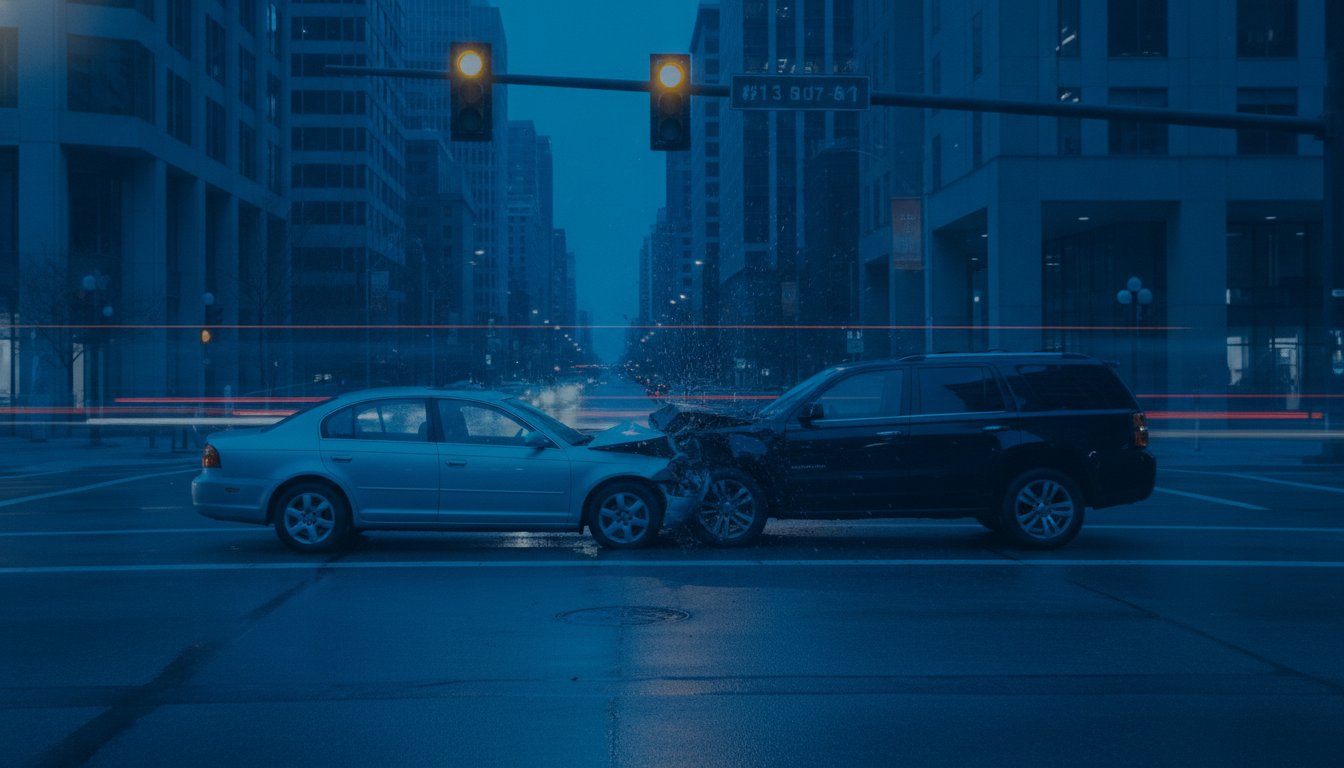
A side-impact collision, or What is a T-Bone Car Accident, occurs when the front of one vehicle strikes the side of another at a perpendicular angle. These incidents are technically known as broadside crashes. In many cases, determining t-bone car accident fault is difficult because it requires reconstructing the exact sequence of events at an intersection. Unlike rear-end collisions, where the following driver is usually presumed liable, side-impacts often involve disputes over who had the right-of-way or who entered the "box" illegally.
These crashes are particularly dangerous due to the "Zone of Vulnerability." While the front and rear of most vehicles are designed with extensive crumple zones to absorb energy, the sides of a car offer very little structural protection. Only the thickness of the door and the window glass separates the occupants from the oncoming vehicle. This lack of a buffer often leads to severe injuries, even when the traveling speeds seem relatively low.
The Physics of Side-Impact Collisions
The limited distance between the exterior door panel and the passenger seat means that the force of the impact is transferred almost directly to the person inside. Modern 2026 vehicle models often include advanced side-curtain airbags and reinforced steel pillars to mitigate this risk. However, side-impact safety remains a critical challenge because the frame of the car can easily warp under lateral pressure. Even a low-speed impact can cause significant structural frame damage that renders a vehicle a total loss.
Common Locations for Broadside Crashes
Intersections remain the most frequent site for these accidents. A common 2026 scenario involves "stale" green lights, where a driver accelerates to beat a changing signal and strikes a vehicle already in the intersection. Other frequent locations include:
-
Parking lot exits: Drivers often fail to yield to through-traffic when merging onto a main road.
-
Driveway merges: The "blind exit" phenomenon occurs when parked cars or landscaping obscure a driver's view of oncoming traffic.
-
Four-way stops: Confusion over the order of arrival often leads to simultaneous entry and a mid-intersection collision.
Complexity increases when a t-bone car accident fault assessment must account for a chain reaction. The initial impact often spins the victim's car into other lanes or oncoming traffic, involving three or more vehicles. When this happens, investigators must determine if the second or third impact was a separate act of negligence or a direct result of the first driver's failure to yield. This creates a web of liability that typically requires professional analysis to untangle.
Right-of-Way Rules: Who is Legally at Fault in a T-Bone Collision?
In a side-impact crash, physical damage patterns don't always tell the whole story. Many drivers assume the person who hit the side of the other vehicle is automatically liable. However, t-bone car accident fault is legally determined by which driver had the right-of-way at the exact moment of impact. If a driver runs a red light and is hit by a car traveling through a green light, the driver who ran the light is responsible, regardless of where the damage occurred.
Left-turn scenarios are a frequent source of dispute. Generally, the driver making a left turn must yield to all oncoming traffic. If a collision occurs during this maneuver, the turning driver is often presumed at fault. This presumption can only be rebutted if it's proven that the oncoming driver was traveling at an excessive speed or was distracted. At four-way stop signs, the "first in time" rule applies. This means the first vehicle to reach the intersection and come to a complete stop has the right to proceed first. If two cars arrive at the same time, the driver on the right has the legal right-of-way.
Violations That Lead to T-Bone Liability
Specific traffic violations are the most common indicators of liability. Failing to yield at a flashing yellow or red signal is a primary cause of these crashes. Additionally, disregarding "No Left Turn" or "One Way" signage clearly establishes negligence. Reckless driving, including excessive speed, can shift the burden of proof. For example, if a driver with a green light is speeding so significantly that the turning driver couldn't reasonably judge their distance, the speeding driver may share or hold the majority of the liability. Determining t-bone car accident fault often requires looking beyond the drivers to see if reckless behavior played a hidden role.
Third-Party Liability and Mechanical Failure
Liability isn't always limited to the drivers involved. In some cases, mechanical failures like brake defects or steering malfunctions can cause a vehicle to enter an intersection unexpectedly. In these instances, the vehicle manufacturer might be held responsible through a product liability claim. Municipal negligence also plays a role. If a city fails to repair a malfunctioning traffic light or allows foliage to obstruct a stop sign, the government entity could be liable for the resulting crash.
Sometimes, "phantom drivers" cause a T-bone without ever making contact. If an unidentified vehicle swerves into your lane, forcing you to move into the side of another car, the legal situation becomes highly complex. Identifying these external factors is a critical part of a free case evaluation, as it ensures all responsible parties are held accountable.
Proving Liability: Critical Evidence in Side-Impact Crash Claims
Establishing t-bone car accident fault requires a meticulous collection of data that goes beyond a simple exchange of insurance cards. While the police report serves as a foundational document, it is not the final word on liability. Officers often arrive after the vehicles have been moved or rely on conflicting statements from shaken drivers. To build a compelling case, investigators look at the physical "Point of Impact" on both vehicles. This physical evidence reveals the exact angle and force of the collision, often contradicting a driver's claim that they were traveling at a safe speed.
For a broader perspective on how to manage these documents, you can consult car accident legal resources 2026. These guides provide a structured approach to evidence management. Beyond the cars themselves, physical debris like glass patterns and paint transfer provide a "fingerprint" of the crash. Glass from a side window shattered by a front bumper travels in a specific direction. This helps reconstructionists determine which vehicle was the primary moving force at the moment of impact.
Digital Evidence and 2026 Vehicle Technology
Modern vehicles are equipped with sophisticated data logging systems that offer objective proof of driver behavior. Electronic Data Recorders, commonly known as "black boxes," capture critical metrics such as braking status, steering input, and velocity in the seconds leading up to an impact. Advanced Driver Assistance Systems (ADAS) logs are equally vital in 2026. These logs can prove whether a driver’s emergency braking system engaged or if lane-keep assist was active, indicating their level of attention. Dash cam footage remains the most definitive way to resolve disputes over traffic signal colors. It provides a real-time visual record that is difficult for insurance companies to dispute.
Witness Testimony and Surveillance
When drivers provide conflicting accounts, third-party witnesses become the deciding factor in determining t-bone car accident fault. Statements from trailing drivers are particularly credible. They typically have a clear view of the traffic signals without the bias of being involved in the crash. Investigators also canvass the surrounding area for commercial security cameras or "Ring" doorbell footage. These digital eyes often capture the moments leading up to the collision from an elevated angle. In high-stakes cases involving severe injuries, accident reconstruction experts use all this data to create a 3D simulation of the crash. This provides a clear narrative of how the negligence occurred.
Managing Injuries and Immediate Steps After a T-Bone Crash
Safety is the immediate priority. After a side-impact collision, you should check for hazards like fuel leaks or exposed wiring, as the intrusion into the vehicle's side can easily rupture critical systems. If it's safe to move, relocate to a sidewalk or shoulder away from moving traffic. Once you're in a stable position, start documenting the scene with your phone. You'll need photos of the resting positions of both vehicles, any visible skid marks, and the status of traffic signals. These images serve as objective evidence when insurance adjusters attempt to shift t-bone car accident fault away from their policyholder.
The way you interact with the other driver is equally important. It's a natural reaction to apologize or say "I'm sorry" out of shock, but you must avoid this. In a legal context, an apology can be interpreted as an admission of liability. Stick to exchanging contact and insurance information without discussing the details of how the crash happened. Let the physical evidence and official reports tell the story of the collision instead.